
Understanding Yield and Tensile Strength in TMT Steel Bars
Yield Strength of TMT Bars marks the point where steel begins to deform permanently under load. Tensile Strength of TMT Bars shows the maximum force the bar withstands before breaking. These two values shape every decision in construction projects across India.
TMT bars undergo a special thermo-mechanical process. This creates a strong outer layer and a softer core. The result delivers excellent ductility combined with high strength. Builders rely on these properties daily.
Yield Strength of TMT Bars determines how much stress the bar handles before it bends out of shape forever. Imagine a bar in a beam. It flexes under weight yet returns to position. Once stress crosses the yield point, permanent change occurs. This matters for structures that need some give, like bridges or high-rise frames.
Tensile Strength of TMT Bars comes into play next. It measures the ultimate limit. The bar stretches further and further until it snaps. This value proves vital when maximum load capacity counts.
How the tests work together
Engineers perform stress-strain tests on samples. The curve starts steeply. It reaches the yield point first. Then the material flows. Finally, it hits the peak at ultimate tensile strength before fracture.
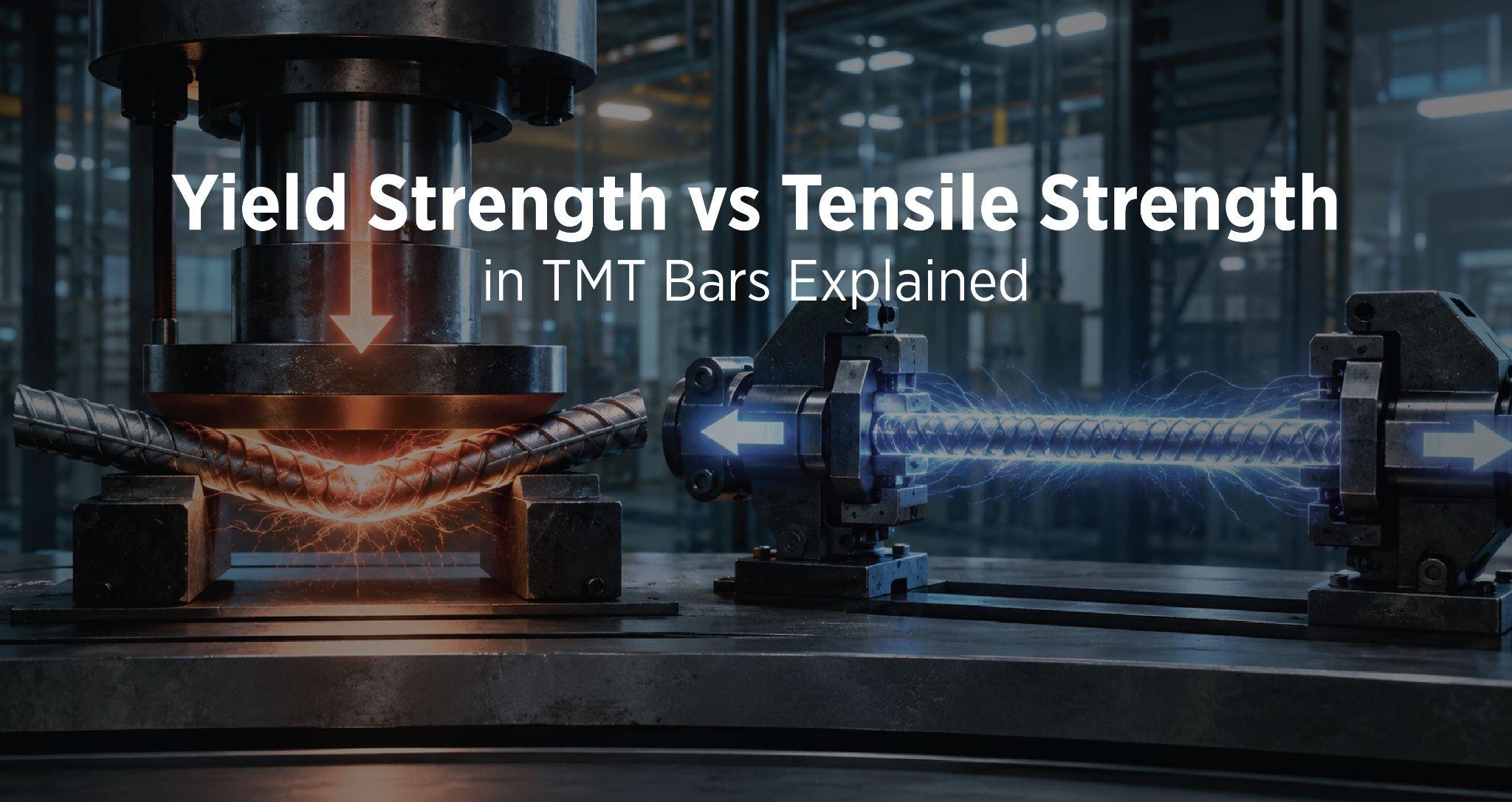
Yield Strength vs Tensile Strength reveals key differences. Yield strength signals the start of plastic deformation. Tensile strength marks the endpoint. Ductile materials show a clear separation between the two. Brittle ones break almost immediately after yielding.
TMT Bar Strength Comparison highlights why these bars outperform ordinary mild steel. This saves material costs while meeting strict building codes.
Mechanical Properties of TMT Bars include more than just strength numbers. Elongation percentage shows ductility. Bend test results confirm flexibility. Corrosion resistance adds longevity. Radha TMT excels across all these parameters through precise manufacturing controls.
Production begins with high-quality billets. Controlled heating followed by rapid cooling creates the martensite outer rim. The core stays ferrite-pearlite. This dual structure balances strength and toughness perfectly.
Different grades exist. Fe500, Fe550, and Fe600 represent common options. Each grade lists minimum yield and tensile requirements. TMT Bar Strength Comparison becomes straightforward when reviewing these standards. Higher grade numbers deliver greater strength for demanding applications.
Consider a simple example. A construction site needs bars for columns. The design specifies certain load values. Selecting the right grade based on the yield strength of TMT Bars and the tensile strength of TMT Bars prevents future issues. Safety margins stay intact.
Mechanical Properties of TMT Bars from Radha TMT consistently meet or exceed BIS standards. Uniform rib patterns improve bonding with concrete. This grip transfers loads effectively throughout the structure.
What happens during actual use? Loads come from multiple directions. Wind, earthquakes, and daily wear. Bars must absorb energy without sudden failure. Good yield strength provides that warning zone. Tensile strength ensures the ultimate barrier remains high.
Yield Strength vs Tensile Strength guides material selection every time. A bracket needs sharp bends. Yield strength allows forming without cracks. A suspension cable demands pure pulling resistance. Tensile strength takes priority there.
Radha TMT bars undergo rigorous testing at every stage. Laboratories check samples from each heat. Results feed back into process adjustments. Consistency across batches becomes the norm rather than the exception.
Why these properties matter in real projects
High-rise buildings sway gently in the wind. Yield Strength of TMT Bars accommodates that movement. Bridges expand and contract with temperature. Proper tensile values prevent catastrophic breaks. Infrastructure projects across the country depend on these characteristics daily.
TMT Bar Strength Comparison shows clear advantages over older cold-twisted bars. Better weldability, higher fatigue resistance, superior earthquake performance. All these stem from optimised mechanical properties.
Engineers calculate based on yield strength for service conditions. They verify against tensile strength for extreme events. Both values work together in design software and manual checks.
Mechanical Properties of TMT Bars also influence cost efficiency. Stronger bars mean fewer pieces or smaller diameters for the same job. Transportation becomes easier. Installation speeds up.
Radha TMT maintains strict quality protocols. Each bundle carries traceability codes. Customers verify authenticity easily. Performance matches the promised numbers on every site.
FAQs
What is the typical yield strength range for TMT bars?
Most grades start from 500 N/mm² upwards. Specific values depend on the grade selected for the project.
Why choose Radha TMT for construction needs?
Consistent Mechanical Properties of TMT Bars, combined with reliable supply and strong bonding characteristics, make it a preferred choice.
Can TMT bars with high tensile strength bend easily during fabrication?
Yes. The manufacturing process preserves ductility. Bars form into stirrups and hooks without cracking when proper tools and techniques are used.
Understanding the yield strength of TMT Bars and the tensile strength of TMT Bars leads to smarter choices. Yield Strength vs Tensile Strength analysis ensures structures stand strong for decades. TMT Bar Strength Comparison confirms the edge modern bars hold. Mechanical Properties of TMT Bars from Radha TMT bring together all the required qualities in one reliable product.
Every beam, column, and foundation benefits from this knowledge. Construction teams select materials confidently. Projects progress smoothly. Final structures deliver safety and performance that last.