

Why Radha TMT Bars are a Smart Choice for Sustainable Projects
With global warming becoming a reality every passing second, sustainable construction is the need of the hour. More structures and people are added as cities expand and change. In a world, you know, where every nail and beam counts toward a greener tomorrow, sustainable building materials can heavily contribute to a project’s ecological credibility.
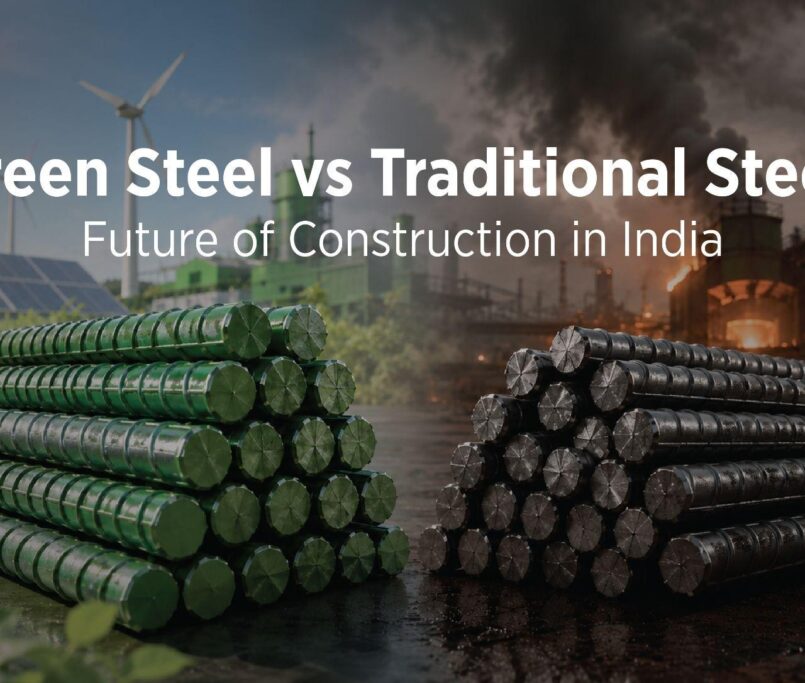
Sustainable projects require the use of steel bars that don’t mess with Mother Earth. Major Steel giants now carry an innate responsibility to combine ecological responsibility alongside structural integrity.
Among the forward-thinking developers who have carved a name for themselves as an environmentally responsible steel giant, Radha TMT bars is one name that’s leading the race with the first company in Andhra Pradesh and Telangana to receive Green Pro Certification.
GreenPro offers consumers product information and points them in the direction of sustainable products. The steel industry has long been at the forefront of infrastructure development and industrial growth. GreenPro Certification is one recognised benchmark for sustainable products. Green buildings maximise the use of water and electricity, utilise environmentally friendly materials, and produce less trash. These days, the cost of green construction goes up by two to three per cent. The additional costs are recovered in two to three years with a notable reduction in operational expenses.
Radha TMT, as one of the Top TMT companies in Hyderabad, has raised the bar when it comes to green steel production. Thermally modified TMT steel through proprietary processes represents not merely a construction material but rather a philosophical statement about building practices for tomorrow’s world. More than that, here are the benefits of what sustainable construction brings to the table.
1) Improved Performance and Building Efficiency
Conventional wisdom suggests that structural robustness necessitates substantial material usage, yet Radha TMT steel bars elegantly contradict this assumption. Radha TMT’s different types of steel bars are strong evidence of this. Structures embracing these reinforcement bars exhibit extraordinary resilience against not only vertical loading stresses but also lateral forces, particularly relevant in regions prone to earthquakes or severe windstorms. Their exceptional ductility allows microscopic deformation without catastrophic failure, essentially “breathing” with applied forces rather than resisting them to the breaking point.
More remarkably still, architects utilising Radha TMT can achieve identical structural parameters while specifying significantly reduced quantities, sometimes achieving material reduction compared with conventional alternatives. The resulting buildings simultaneously showcase improved performance characteristics while requiring fewer raw resources, truly embodying the “more from less” philosophy fundamental to genuine sustainability practices.
Related Link: Radha TMT’s Green Steel: Shaping a Sustainable Tomorrow
2) Green Pro Certification for Energy-Efficient Buildings
It’s hard for many construction professionals today to tell the difference between companies that truly care about the environment and those that just pretend to be eco-friendly for marketing. Radha TMT’s acquisition of the coveted Green Pro Certification, awarded only after a painstaking assessment of numerous production parameters, eliminates such uncertainty serving as the the primary advantage of TMT bars.
Curiously overlooked yet scientifically significant, the molecular arrangement achieved during Radha TMT’s specialised heat treatment profoundly influences thermal transfer properties within concrete structures. The optimised crystalline formation disrupts heat conduction pathways, effectively creating microscopic insulation networks throughout reinforced elements. Buildings constructed with these thermally intelligent bars demonstrate measurably improved thermal stability, resisting external temperature fluctuations more effectively than traditionally reinforced counterparts.
3) Long-term Cost Savings
Initial investment hesitation frequently obscures the compelling financial wisdom behind selecting premium construction materials. Radha TMT’s exceptional corrosion resistance, particularly crucial in coastal regions or areas with elevated groundwater acidity, dramatically extends structural integrity timelines. While conventional reinforcement might necessitate expensive remediation within 15-20 years in aggressive environments, Radha TMT reinforced structures frequently maintain pristine condition far beyond these intervals, postponing or eliminating costly rehabilitation projects.
Related Link: Radha TMT: Paving the Path to a Greener Future with Eco-Friendly Steel
4) Waste Reduction and Resource Conservation
Within manufacturing environments traditionally associated with substantial resource consumption, Radha TMT facilities stand apart through innovative circularity approaches. Unlike conventional steel production processes, which often generate substantial non-recoverable byproducts, their manufacturing cycle incorporates sophisticated recapture systems that collect and reprocess virtually all secondary materials generated during production. Cooling water undergoes advanced filtration, allowing near-infinite reuse cycles, while thermal energy from finished products redirects into preheating incoming stock, dramatically reducing overall energy requirements and resource consumption.
5) Carbon Footprint Reduction
Radha TMT manufacturing processes incorporate numerous innovations specifically targeting greenhouse gas reduction throughout production. Their facilities prioritize energy efficiency through the installation of variable frequency drives on major equipment, heat recovery systems capturing and repurposing thermal energy, and optimized production scheduling maximizing equipment utilization during operation.
Moreover, the extended functional lifespan of structures reinforced with these premium bars creates a crucial yet frequently overlooked carbon advantage: amortisation of initial emissions across significantly lengthened building lifecycles. For instance, a structure serving functional purposes for 75+ years rather than requiring replacement after 50 effectively distributes its embodied carbon cost across additional decades of utilisation, reducing annualised climate impact.
Conclusion
As construction professionals increasingly recognize the inseparable relationship between building quality and environmental stewardship, Radha TMT’s green steel offers ever-greater prominence in forward-thinking projects. They offer the best TMT bars, whose adoption signals more than mere material selection, it represents a commitment to structures that stand not only physically strong but also environmentally sound for generations to come.
FAQs
Which TMT bar is good for house construction?
Radha TMT bars is among the best TMT bars for house construction. They combine strength, reliability, durability, and innovation to deliver the best outcome.
What is sustainability in construction materials?
Sustainability in construction material refers to the involvement of material that minimizes the environmental impact while at the same time maximizing the social benefit through their lifecycle.
What is the recognised certification to ensure sustainable construction?
GreenPro certification is the recognised certification to ensure sustainable construction.
GreenPro is a type 1 eco-labelling program owned by CII GBC that considers a range of criteria across a product’s life cycle.