
A Complete Guide to TMT Bar Quality Standards (ISI, BIS, ISO)
Steel arrives at site looking the same, whether it comes from a disciplined plant or a careless one. The difference isn’t visible in colour or shine. It shows up later, in bending, in load behaviour, sometimes years down the line. That’s why quality standards exist in the first place.
Before anything else, the TMT full form, Thermo Mechanically Treated. It’s simply the way the bar is processed. The steel is heated, then cooled rapidly on the outside while the inside stays hot for a bit longer. That temperature difference creates a hard outer layer and a softer core. Strong on the surface, flexible inside. That balance is the reason TMT bars replaced the old plain mild steel bars.
BIS Certification for Steel: What It Really Means
In India, reinforcement steel falls under IS 1786, issued by the Bureau of Indian Standards. When people refer to BIS certification for steel, they’re talking about compliance with this document. It sets limits. Yield strength must meet a minimum number. Elongation cannot fall below a defined percentage. Chemical elements like carbon and sulphur are capped. Bend tests are mandatory.
Those numbers are not decorative. If elongation is low, ductility drops. If carbon is too high, weldability suffers. If yield strength fluctuates, design assumptions stop matching reality.
ISI Mark: What to Check on Site
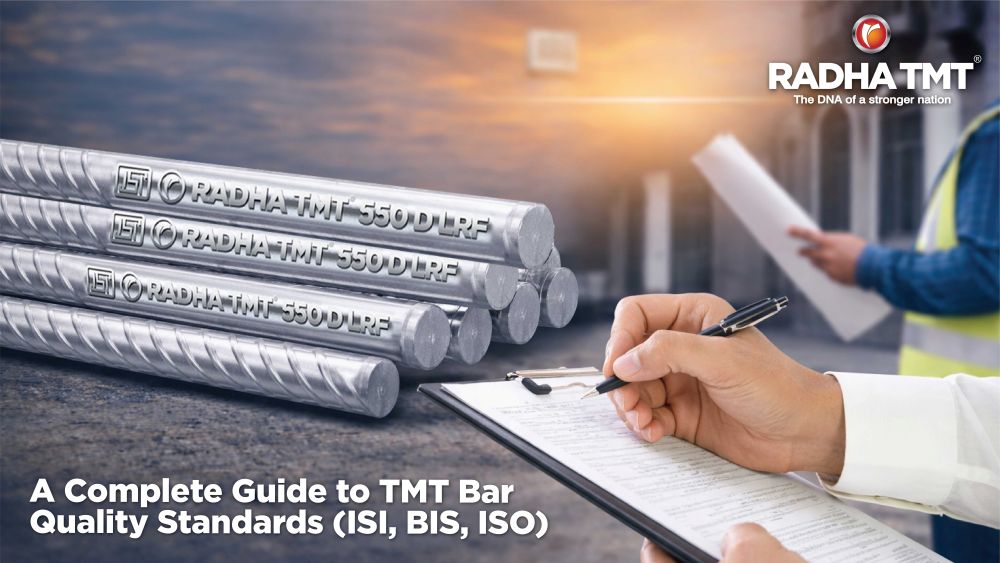
The ISI mark stamped on the bar signals that the manufacturer holds a BIS license. There’s usually a license number printed along with it. That number ties the product back to a plant operating under inspection. On site, this marking is often the first thing worth checking before unloading a truck.
ISO certification comes up in conversations too. It relates to how the company manages its processes, documentation, audits, quality systems. Useful, definitely. But ISO alone doesn’t guarantee that a particular batch of reinforcement meets IS 1786 mechanical properties. For structural steel, BIS compliance is the core requirement.
Understanding Fe 500 TMT Bar and Other Grades
A Fe 500 TMT bar indicates a minimum yield strength of 500 MPa. It’s common in residential construction and mid-rise buildings. For seismic regions, Fe 500D is often chosen because it offers higher ductility. Higher grades like Fe 550 are used where structural loads demand additional capacity or where steel optimization is part of the structural design.
There have been different types of steel bars over the years, plain mild steel, HYSD, and now TMT. The shift happened because performance expectations increased. Structures became taller. Codes became stricter. Materials had to respond.
Why Standards Matter in Practice
In practical terms, certification brings predictability. When steel is manufactured under BIS norms, its properties fall within expected ranges. Bars bend as they should during fabrication. Development lengths behave as calculated. Structural detailing stays valid.
Radha TMT produces reinforcement under BIS licensing, maintaining controlled manufacturing parameters. On site, that translates into consistent rib patterns, proper weight per meter, and mechanical properties that align with specification.
Reinforcement steel is not something you revisit after casting. The only window to confirm quality is before placement. Markings, grade, certification, those checks take minutes, but they carry decades of consequence.
Standards don’t make steel stronger by themselves. They ensure that what is specified on paper is what arrives on site.
FAQs
- What is the full form of TMT?
TMT stands for Thermo Mechanically Treated, referring to the heat treatment process that strengthens the steel while maintaining ductility. - What does BIS certification mean for TMT bars?
It means the steel complies with IS 1786 standards for strength, elongation, chemical composition, and testing requirements. - What is the difference between BIS and ISI?
BIS is the standards authority. ISI is the certification mark indicating compliance under a BIS license. - Is Fe 500 TMT bar suitable for home construction?
Yes. Fe 500 is commonly used in residential buildings due to its strength and balanced performance.