

How to Identify TMT Bars from Regular Steel Bars: The Inside Scoop
Steel reinforcement is the backbone of every structure, but builders and home owners do not know the major difference between various steel bars. The information about TMT bars and other steel bars can be the difference in longevity, safety, and overall building cost of your next project. In this in-depth guide, we will assist you in making the right choices in using reinforcement materials for your next project.
Appreciating the Fundamental Difference Between TMT Bars and Ordinary Steel Bars
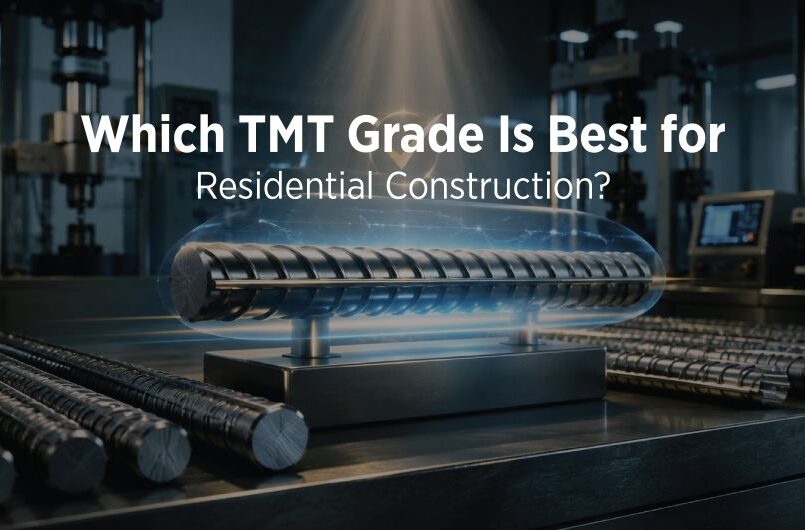
TMT bars are a technological wonder, one higher than the ordinary mild steel bars. The production process is such that the two are distinct even at the level of molecules. TMT bars get specially treated with the heat-treated steel being passed through a water cooling plant immediately after rolling. Quenching consequently creates a hard outer shell and a soft, ductile inner core.
Straight steel bars, instead, embrace traditional production methods in lieu of such heat treatment. They slow down at room temperature, causing an even structure to form within the bar. This ordinary variation in the process of production creates highly differing mechanical properties, which make TMT bars more appropriate for use in modern construction practices.
The microstructure is self-explanatory. TMT bars consist of a hard martensitic rim over a ferrite-pearlite center, with unbeatable strength without sacrifice to flexibility. Mild steel bars consist of an irregular structure sans this excellent combination of hardness and ductility.
TMT vs Mild Steel Bars: Features at a Glance
Assessing the features of TMT vs. mild steel bars, some differences are evident that construction professionals need to consider.
Strength Properties: TMT bars offer much more tensile strength, typically ranging between 500 to 600 MPa, while mild steel bars offer approximately 250 MPa. This factor of strength enables you to utilize fewer bars or lower sizes and hence save on material cost without undermining structural stability.
Ductility and Flexibility: While their strength is better, TMT bars are very ductile. They can be bent without fracturing and are thus most appropriate for seismically vulnerable regions. Mild steel bars, while being ductile to a certain degree, cannot match in performance, particularly with seismic loads.
Corrosion Resistance: The outer martensitic sheathing of TMT bars possesses a natural resistance to corrosion, which prolongs the life of the structure. Steel bars lack this protective cover and rust at an extremely high rate when subjected to water and environmental forces.
Weldability: TMT bars have very high weldability without any compromise on their mechanical properties. They are not weakened by welding, but mild steel bars can be weakened structurally at the welding points.
Thermal Stability: The structures are susceptible to fire hazards, and the TMT bars also excel in this criterion. They have structural stability at 600 degrees Celsius, providing critical extra time to evacuate in case of emergencies. Mild steel bars lose strength very rapidly under the same temperature.
How to Identify Genuine TMT Bar: Must Quality Markers
The market is flooded with low-quality products claiming to be quality TMT bars. The power to identify original TMT bars protects your investment and construction safety.
Physical Examination Methodologies: Original TMT bars exhibit some physical features. Observe the rib pattern, original TMT bars feature evenly spaced, close ribs along the axis. The bar surface should not be spotted with rust, scaling, or marks, having a typical luster.
Brand Markings: Legitimate manufacturers impress their brand name, grade, and size on the bars at regular time intervals. The markings must be distinct, permanent, and consistent. Poor markings are a sure tip-off as far as authenticity is concerned.
Bend Test: The Bend test is a speedy test that indicates quality. The initial TMT bars were bendable up to 180 degrees without crack or breakage. Have this test conducted before purchase in bulk, good manufacturers make such testing possible.
Chemical Composition Certificate: Always demand test certificates from producers. Such certificates define carbon content, sulphur, phosphorus, and percentages of other elements. High-quality TMT bars in India satisfy strict chemical composition criteria laid out by the Bureau of Indian Standards.
Weight Verification: Compute theoretical weight based on bar diameter and length. Gross variances indicate probable quality compromises. Genuine manufacturers maintain strict weight tolerances.
Selecting the Indian best TMT bar for Your Project
The Indian construction industry has witnessed explosive growth with a number of producers vying for market share. Selecting the best TMT bar in India includes evaluation of a few parameters beyond marketing assertions.
Certification and Compliance: The leading producers are ISI certified and in accordance with IS 1786:2008 norms. Verify BIS (Bureau of Indian Standards) certification marks on the physical bars. Certification will verify that the product is at least up to minimum quality standards.
Manufacturing Technology: Top companies employ superior thermex technology and state-of-the-art rolling mills. This technological superiority automatically shows up in improved product consistency and mechanical properties.
Track Record and Reputation: Established brands with a long history generally provide consistent quality. Research the background of the factory, the projects they have completed in the past, and customer feedback before making a purchase.
After-Sales Support: High-quality manufacturers provide technical support, which helps engineers and contractors achieve optimum bar performance for particular applications. The after-sales support is a massive value addition to the product itself.
Focus on Quality: Radha TMT
Of the many choices in the Indian market, Radha TMT has emerged as a choice that can be trusted for construction activity. Radha TMT is committed to continuous quality inspection and is based on world-class manufacturing techniques that ensure product dependability.
Radha TMT bars are stringently quality-checked at each stage of production to ensure that every bar is up to standard. Their dedication to technology upgradation and quality assurance makes them a possible option to consider for your building requirements.
Choosing the Best Option: Real-Life Experience
When choosing between TMT and normal steel bars, the following real-life factors are to be taken into consideration:
Project Specifications: TMT bars are required for seismic buildings, bridges, and high-rise buildings. Mild steel can be employed for low, non-essential buildings, but TMT is always the first choice.
Budgeting: Though the initial price of TMT bars is higher, their strength allows for the utilization of fewer bars and hence lesser overall expenses. Consider long-term expenditure in the form of better durability and reduced maintenance.
Location Factors: Coastal or wet regions need more corrosion protection in TMT bars. Plain steel bars can easily corrode in these environments.
Future Considerations: Structural extension construction becomes easier with the help of TMT bar foundations. More strength and ductility provide extra loads to better support them.
Conclusion
Understanding the difference between TMT bars and regular steel bars provides you with the power of knowledgeable building decisions. The higher strength, ductility, resistance to corrosion, and seismic resistance of TMT bars make them the first choice for modern building. Even though regular steel bars might seem cost-competitive in the starting, TMT bars are long-term value-competitive in terms of increased strength and longevity in building.
Take the time to learn how to recognize authentic TMT bars, how to check certifications, and choosing veteran manufacturers. Your building’s safety and durability depend on these important decisions. In making your selection among well-known brands or newer firms like Radha TMT, choose quality, certification, and established track record over cost.
The advantages of TMT over mild steel bars are readily discernible as to why modern building regulations increasingly mandate the use of TMT. With modifications to construction codes and safety regulations being made stricter, TMT bars are not only an alternative but the norm in prudent construction practices. Be smart about it, your building is worth it.