
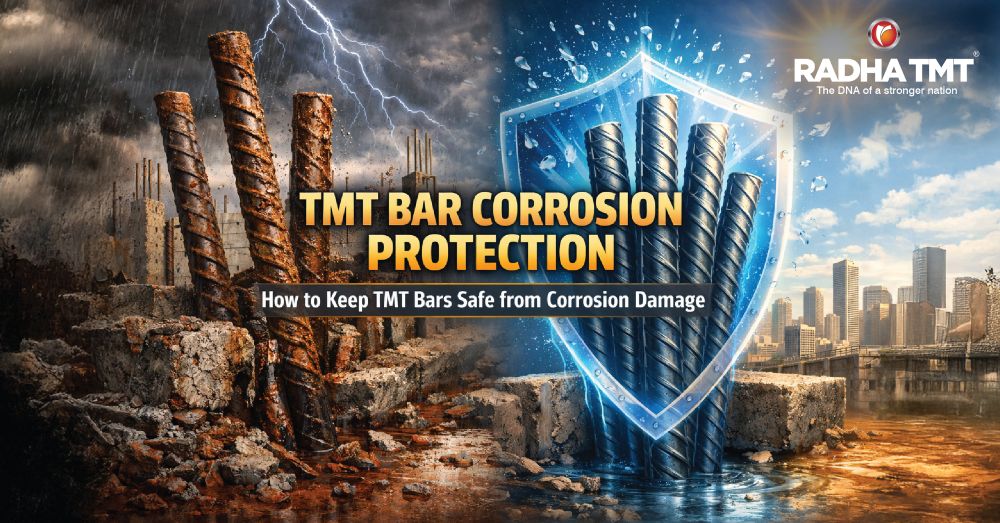
TMT Bar Corrosion Protection: How to Keep TMT Bars Safe from Corrosion Damage
Corrosion doesn’t show up on day one.
It comes later. Slowly. When the building is already in use.
That’s why corrosion is often misunderstood. People think it’s a future problem. In reality, it’s decided very early, at the stage where TMT bars are chosen, stored, and placed.
If you’re building a home or managing a site, TMT bar corrosion protection is not a separate topic. It’s part of doing the basics right.
Why corrosion happens in the first place
TMT bars are steel. Steel reacts with moisture and air. That reaction leads to rust.
Once rust starts, it expands. That expansion puts pressure on the surrounding concrete. Over time, the bond between steel and concrete weakens. The steel section reduces. Load capacity drops.
The structure may still look fine from outside. Inside, it’s not performing the way it should.
That’s why corrosion is treated as a structural issue, not a surface issue.
Corrosion resistance of TMT bars starts at manufacturing
Not all TMT bars behave the same over time. The difference usually comes from how the bar is made.
TMT bars produced through the German Thermex process develop a hardened outer surface with a tougher inner core. This outer layer slows down the entry of moisture and oxygen, which helps delay corrosion.
Consistency matters here.
Cooling control.
Surface quality.
Chemical balance.
When these are managed properly, the corrosion resistance of TMT bars improves noticeably.
Manufacturers like Radha TMT focus on controlled production so the steel behaves predictably once it’s inside concrete. That predictability is what helps structures age better.
TMT bars rust prevention depends a lot on site discipline
Good steel can still corrode if it’s mishandled.
Storage is the first issue.
Bars lying directly on soil pick up moisture constantly. Raising them off the ground is a small step that makes a real difference.
Water exposure is another.
Steel left in stagnant water starts oxidising faster. Drainage on site matters more than people think.
Surface condition matters too.
Light surface rust is common and usually not a problem. Loose, flaky rust is different. That needs to be cleaned before concreting.
Then there’s concrete cover.
Insufficient cover allows moisture to reach steel earlier. Proper cover acts as long-term protection. This is basic RCC work, but it’s often compromised on site.
These steps are simple. Ignoring them isn’t.
Environment changes the risk level
Some locations face higher corrosion risk than others.
Coastal areas deal with salt in the air.
High rainfall regions deal with constant moisture.
Industrial zones may introduce chemical exposure.
In such conditions, steel quality and site practices matter even more. Choosing reliable TMT bars and handling them correctly slows down corrosion and extends the life of the structure.
There’s no shortcut here. Only discipline.
Cost thinking needs a longer view
Material decisions are often influenced by the iron rate today. That’s understandable. Steel prices fluctuate, and budgets matter.
But corrosion protection shouldn’t be judged only on the steel rate per kg.
Cheaper steel that corrodes faster leads to repair costs later. And corrosion-related repairs are rarely simple or cheap once the concrete is cast.
Steel that performs better over time usually offers better value, even if the initial price looks slightly higher.
The practical takeaway
Corrosion protection isn’t one feature.
It’s a chain.
Manufacturing quality.
Storage on site.
Handling before placement.
Concrete workmanship.
Break any one link, and corrosion finds its way in.
Radha TMT focuses on consistent quality and controlled processes so the steel holds up under real site conditions. When combined with proper site practices, this helps RCC structures remain durable over the long term.
No steel stays perfect forever.
But the right choices slow damage down.
And in construction, slowing damage is often the difference between a structure that lasts and one that needs fixing too early.
Faqs
Q: Why do TMT bars corrode even inside concrete?
Because concrete isn’t airtight. Water moves slowly, but it does.
Over time it reaches the steel.
That’s enough for corrosion to begin.
Q: Are TMT bars actually better at resisting corrosion?
Yes.
Not perfect.
Just better.
The outer layer is harder because of the Thermex process.
Moisture takes longer to get in.
That delay helps.
Q: Is rust on TMT bars before use a problem?
Some rust is normal.
Thin. Surface level. Nothing to panic about.
But if it’s flaky or coming off on your hands, clean it.
That steel’s been sitting wet too long.
Q: Does site storage really make a difference?
A big one.
Steel on soil stays damp.
Steel in water reacts fast.
Lift it. Keep it dry and you’ve already reduced risk.