
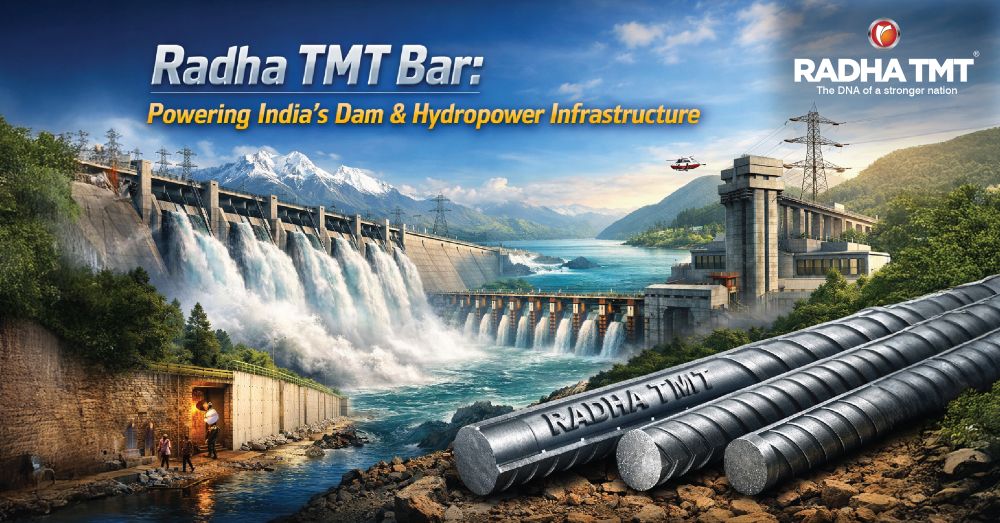
Radha TMT Bar: Powering India’s Dam & Hydropower Infrastructure
Introduction: Steel That Holds Nations Together
Massive concrete walls. Millions of gallons are pressing against engineered barriers. Turbines spinning endlessly to light up cities.
What holds it all together? TMT bars for dams.
TMT full form—Thermo-Mechanically Treated—sounds technical. It is. This manufacturing process transforms ordinary steel into something extraordinary. India’s hydropower sector? It runs on these reinforcement bars. Has for years.
Understanding TMT Technology: The Science Behind Superior Strength
Here’s what happens during production.
Rapid water cooling hits the steel. Then atmospheric tempering follows. The result? A three-layer structure nobody sees, but everyone depends on. Hard martensite forms the outer shell. Inside sits soft, ductile ferrite-pearlite.
Why does this matter?
Consider the properties:
- Tensile strength touching 550-600 MPa
- Elongation capacity that saves structures during earthquakes
- Flexibility for designs that seem impossible
- Weldability that construction crews appreciate
Why TMT bars are used in dams stops being a question when you examine these characteristics. Strength meets ductility. Rigidity bends when it needs to.
Best Reinforcement Bars for Dams: Essential Properties That Matter
Corrosion Resistance: Fighting Water’s Relentless Attack
Water never stops attacking steel. Chemical reactions happen slowly, invisibly, dangerously.
The best reinforcement bars for dams fight back through microstructure design. Radha TMT bars feature specialized grain patterns that resist rust formation. Ribbed surfaces? They create bonds with concrete that water struggles to penetrate.
Hydraulic Pressure Resistance
Picture the forces at work here.
Thousands of tons are constantly pushing against concrete. Water levels rise and fall. Flood conditions bring surge pressures that would crush weaker materials.
TMT bars for dams absorb these stresses through tensile strength. High-grade steel gives concrete what it desperately lacks. Brittle materials become resilient composites. The transformation seems almost magical.
It’s just good metallurgy.
Seismic Performance
Earthquakes don’t schedule appointments. India sits on active fault lines. Many hydropower facilities operate in zones where ground movement happens regularly.
Ductility saves lives here. Quality TMT bars in hydropower plants flex during seismic events rather than snap. Energy gets absorbed instead of transmitted. Structures bend, survive, and continue functioning.
Rigid materials crack. Ductile ones adapt.
TMT Bars in Hydropower Plants: Comprehensive Applications
Primary Dam Structures
Dam walls need extensive reinforcement networks throughout the concrete. Radha TMT bars create this framework inside the structure. Spillways control water overflow during heavy rains. The water flowing over spillways moves at high speed and creates strong erosive forces. Abutments connect the dam to the valley sides. These connection points need excellent bonding between steel and concrete to hold everything together.
Each element serves a purpose. Miss one and consequences follow.
Powerhouse Infrastructure
Machinery weighs tons. Vibrations never stop.
Heavy equipment foundations require layouts designed with precision:
- Turbine pedestals bearing rotating masses
- Generator foundations handling constant vibration
- Crane rails supporting maintenance equipment
- Control room frames protecting sensitive electronics
Radha TMT handles these applications because consistency matters. Variation means failure eventually.
Water Conveyance Systems
Penstock tunnels carry pressurised water through mountains. Intake towers regulate flow from reservoirs above. Surge chambers protect against water hammer, pressure spikes that can rupture inferior materials.
Perpetual water contact defines these structures. Corrosion resistance stops being optional. The oxide layer on TMT bars in hydropower plants becomes crucial for durability measured in decades, not years.
Tailrace and Discharge Channels
Power generation ends. Water still needs to be routed back to the rivers safely.
Tailrace structures handle high-velocity discharge that erodes rock given enough time. Energy dissipation basins require steel maintaining strength despite turbulence that never stops.
Best reinforcement bars for dams provide the durability these applications demand. Compromise here? The entire system suffers.
Why Choose Radha TMT: Engineering Excellence for Nation-Building
Quality Standards and Manufacturing Excellence
Radha TMT bars meet industry specifications for High Strength Deformed Steel Bars. Testing happens continuously. Quality control never sleeps.
Every batch undergoes examination:
- Chemical composition gets analyzed
- Tensile strength faces verification
- Bend testing confirms ductility
- Weight tolerances stay within limits
This commitment makes Radha TMT trusted for critical infrastructure. Trust gets earned through consistency.
Advanced Manufacturing Process
Production facilities employ temperature control measured in degrees. Quenching systems achieve cooling patterns that depend on uniformity. Automated handling maintains dimensional accuracy because human hands vary.
Why TMT bars are used in dams built with Radha TMT? Quality control stays consistent. Structural safety deserves attention to manufacturing details that seem minor until they become catastrophic.
Details matter. Always have.
Long-Term Economic Considerations
Initial costs tell partial stories. Lifecycle performance reveals true value.
Radha TMT bars deliver:
- Service life extending beyond typical expectations
- Maintenance requirements that stay manageable
- Fatigue resistance for loading cycles that never end
- Repair costs stay lower throughout operations
Infrastructure investments benefit from materials designed for longevity. Shortcuts cost more eventually.
Technical Support and Expertise
Choosing Radha TMT means accessing engineering knowledge accumulated through years of practical experience. Design assistance helps optimize reinforcement layouts. Site support maintains proper installation practices.
Partnership matters. Projects succeed through collaboration, not just material delivery.
Conclusion: Building India’s Energy Future with Radha TMT
Hydropower generates clean electricity. Renewable energy that rivers provide endlessly.
Dams offer irrigation, flood control, and water security. Communities depend on these structures. Economic growth follows a reliable power supply.
The foundation? TMT bars for dams deliver strength and reliability.
Radha TMT manufactures the best reinforcement bars for dams and hydropower facilities across India. Superior metallurgy combines with consistent quality. Performance speaks through structures still standing strong.
When structural integrity matters. Choose steel manufactured with precision. Choose Radha TMT.
Frequently Asked Questions
Q1: What is TMT’s full form, and how does this technology benefit dam construction?
TMT stands for Thermo-Mechanically Treated steel. The manufacturing process creates hard outer layers protecting ductile cores. High strength meets flexibility in one material. Structures facing massive hydraulic pressures and seismic forces need both properties. Dam applications demand this combination. Conventional steel cannot provide it.
Q2: Why are TMT bars specifically used in dams instead of conventional steel?
Corrosion resistance becomes essential when water contact never stops. High tensile strength reinforces concrete required for hydraulic loads. Earthquake-resistant ductility protects against seismic damage that conventional steel cannot withstand. These properties make TMT bars valuable in dam construction. Conventional alternatives fall short on multiple criteria simultaneously.
Q3: What makes Radha TMT among the best reinforcement bars for dams and hydropower projects?
Rigorous quality control combined with advanced manufacturing processes. Every batch features a consistent chemical composition verified through testing. Superior bonding characteristics come from specialised surface design. Fatigue resistance handles cyclic loading indefinitely. The microstructure provides corrosion protection suitable for decades of water infrastructure service. Consistency matters more than occasional excellence.
Q4: How do TMT bars in hydropower plants handle dynamic water pressures and operational stresses?
The three-layer structure absorbs energy from water hammer effects and pressure fluctuations. Ductile cores allow flexing without fracture that would doom rigid materials. High yield strength resists deformation under sustained loads lasting years. This combination supports structural integrity throughout continuous operation in demanding environments. Rigid materials crack. Ductile ones survive.